

Sveiki and Happy 2023!
The last few months have been incredible and incredibly busy, so here’s an overview of some of the things I’ve been up to since my last post:
Fall & Winter Holidays


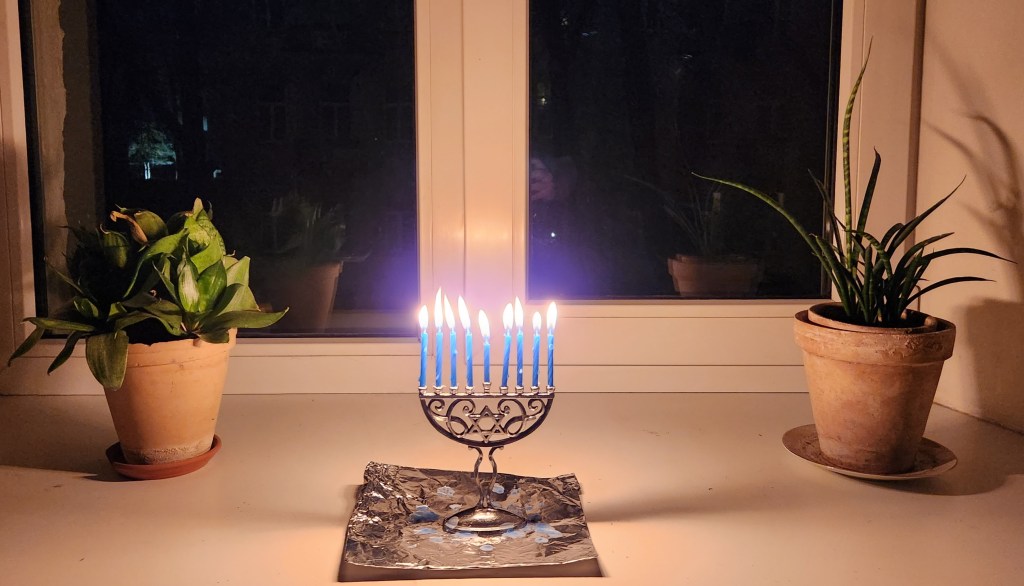
I’ve gotten to celebrate Rosh Hashana and Yom Kippur with the Jewish community here, All Saint’s Day with the Vilnius community, Thanksgiving (three times: two dinners I hosted and one I attended), Chanukah, Christmas, and now New Year’s.
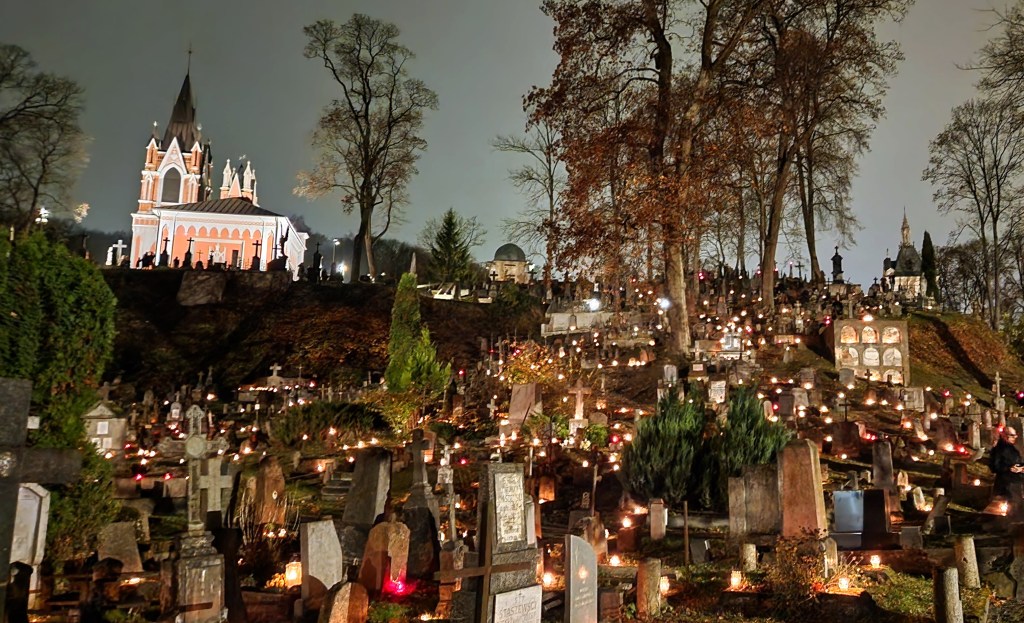
On All Saint’s Day, Lithuanians visit cemeteries and put candles on the graves of their families and national heroes. It’s a solemn holiday, and one that brings light to lost loved ones.
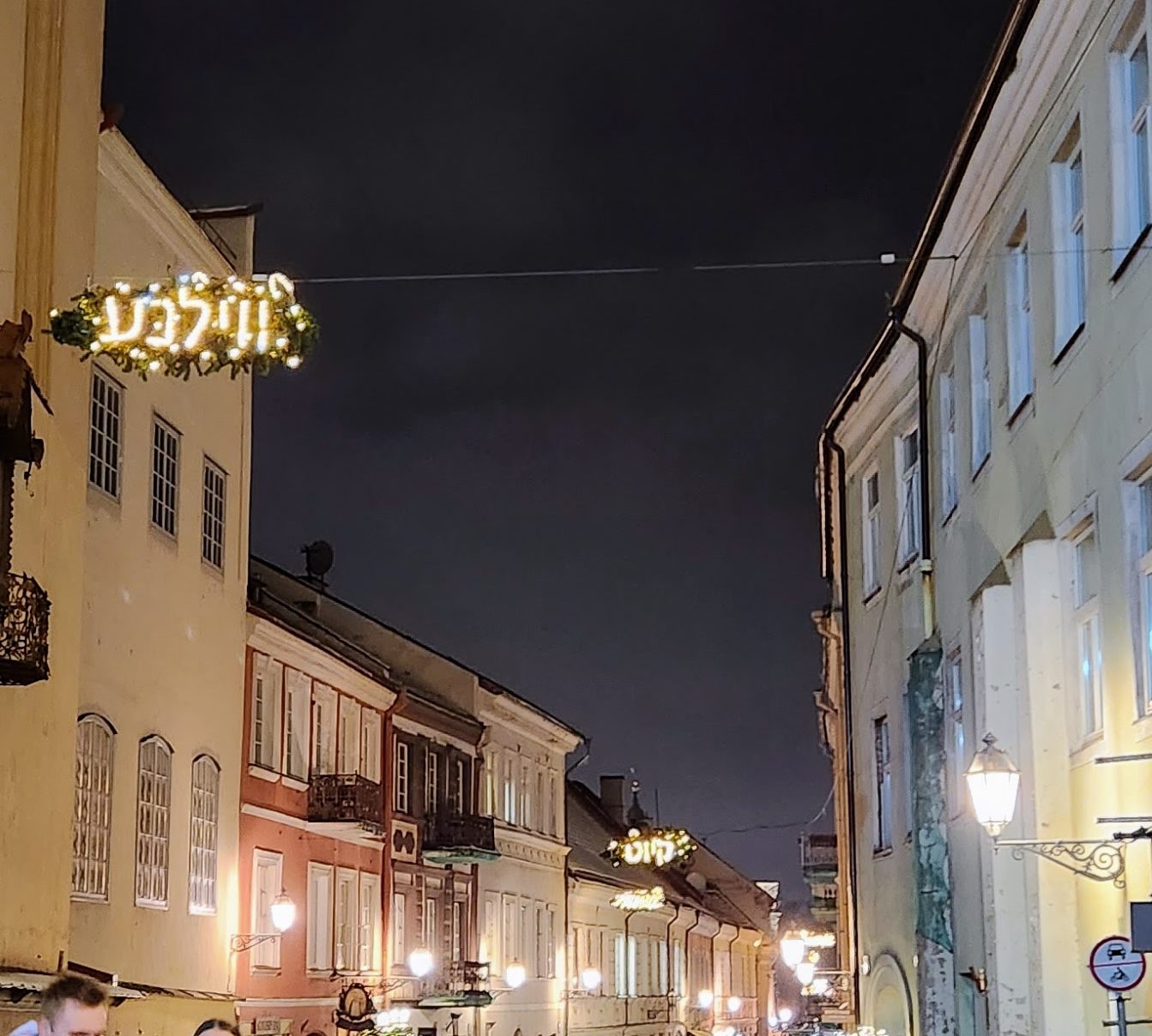
In Winter, Vilnius is transformed. We watched the Christmas tree lighting while we drank karštas šokolado baltas (white hot chocolate) and ate varškė donutes (made from a type of cheese curd). This section of Old Town had “Beautiful Vilnius” strung across the street in all the different languages spoken here, and right near the University was Yiddish! It says: “קיוט ווילע” (cute Vilnius).
Potatoes
While learning both Yiddish and Lithuanian, I’ve found only one word that’s the same: bulvė in Lithuanian and בולבע (bulbe) in Yiddish which both mean ‘potato.’ Considering the overlap of potato dishes in Lithuanian and Jewish cuisine – kugel, latkes, blintzes – it’s not a surprise that this word would be shared. I’ve been wondering which language influenced the other, and if having common words is specific to Litvak (Lithuanian-Jewish) Yiddish.
It feels representative of what I’ve learned of the Jewish community in Lithuania. Before the start of my grant, I’d imagined that there had always been a stark division, especially knowing that Jews weren’t even considered Lithuanian citizens. However, I’ve heard stories of how interwoven the communities were in the inter-war period, especially in the smaller towns.
Rokiškis
Rokiškis (Ro-kish-kiss), Matilda Olkinaitė’s hometown, is one such place. The city’s population used to be 75% Jewish and, according to the historians I’ve spoken to, everyone was friends with one another. No Jews live there now, but each year, there’s day-long celebration dedicated to remembering the Rokiškis Jewish community.
Still, their loss is felt. My first guide walked me through town pointing out each building in the city center and explaining which Jewish family once lived there. He drove me to the site where most of the Jews in the city were killed. (As I wrote in my last post: every town has a mass grave like this.)
My second guide told me that Matilda and her siblings are remembered as being bright and beautiful, and many people speak quietly about the Jewish neighbors they once had. She showed me where Matilda’s house once stood, where the Olkin family were imprisoned, the site of their murders, and the church where her poems survived, hidden by their family friend, the priest. I’m working on a longer post about Matilda’s life and the similarities between our experiences, but reading her poetry in a place where she once lived was haunting, while further bringing her memory to life.
In the center of Matilda’s town just outside of Rokiškis is this carved bench in her memory, the journal on the left carved with the pattern of her diary:

My second guide told me a story that made me laugh: On the Sabbath, when the Jewish kids in Rokiškis wanted to spend time together inside their schoolhouse and it was too dark to see, they would send a sparrow into the building through the window. The resulting racket would be enough to get the neighbors to open the door and turn on the lights to investigate. As you aren’t allowed to turn lights on and off during Shabbat, this was a clever way to get their community to help them without asking another to break the Sabbath.
Ukrainian Center
Since my last post, I started co-leading an English club for Ukrainian refugees at the Ukrainian Center in Vilnius. Studying the Holocaust as a product of the diaspora, and getting to know this community currently being forced from their homes has reminded me of the importance of documenting history so future generations will understand the true horror of what happened.
Some days, while we’re listening to English songs, or learning what to ask when renting a home, it’s easy to forget what they’ve lived through. On other days, my Ukrainian friends will send pictures of their bombed homes and speak of loved ones and pets left behind. Their resilience, bravery, and kindness is a testament to the strength of the Ukrainian people.
The war feels more real here, living so close. In the US there’s the privilege of distance which I think heavily impacts our (Americans’) ability to comprehend the awful reality of what’s happening. There are reminders everywhere here, as there should be.
In this video, you can listen to a Ukrainian folk sung together by the Lithuanian community and Ukrainian refugees. It’s well worth a listen.
Exploring Lithuania
At the start of the grant, one of the other researchers introduced me to a ‘Collect Lithuania’ magnet series where each region sells a magnet that you can only buy there. If you collect them all, they form a map of the country. Not only are these fun souvenirs, they’ve encouraged me to see a lot of places I might not have visited otherwise! So far, I’ve been to:
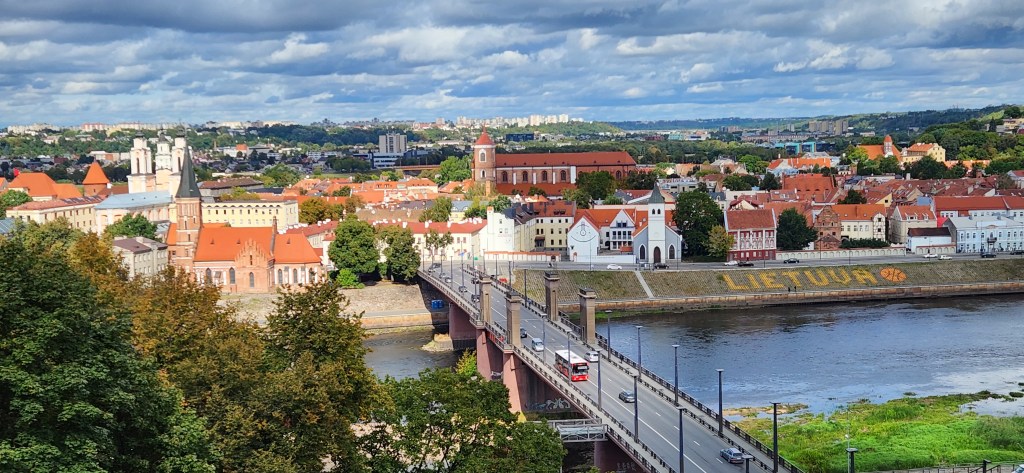
Kaunas – the second largest city after Vilnius, and the European Capital of Culture in 2022. I spent a day here and only just scratched the surface of this beautiful city, but am excited to return to see more!

Druskininkai – a resort town in the south of Lithuania, close to the Belarus border. I attended the Poetic Fall Festival here, and found so much inspiration in being surrounded by beautiful writing in so many languages.
Elektrėnai – a city built by the Soviets for the workers of the electric power plant. We didn’t spend much time here, but we walked along the waterfront for a gorgeous view:

Trakai – a city with a castle you’ll recognize if you’ve ever done a Google image search for ‘Lithuania.’ Right outside of Vilnius, Trakai castle sits on an island and holds so much history. Most of the original castle was destroyed, but was rebuilt on the same foundations––you can see the old stone on the bottom compared to the newer red brick:

Kernavė – a historical pagan site of defensive mounds. I spent hours walking around here, following the trails and making it to an outlook point just as the sun came out:

Prienai – a town I’m sure I wouldn’t have visited without the magnet to inspire a trip there, but so far one of my favorite places. Their regional museum showed their connections to the first flights and literature, and was a reminder that each small town in Lithuania holds more history than you’d think at first glance.
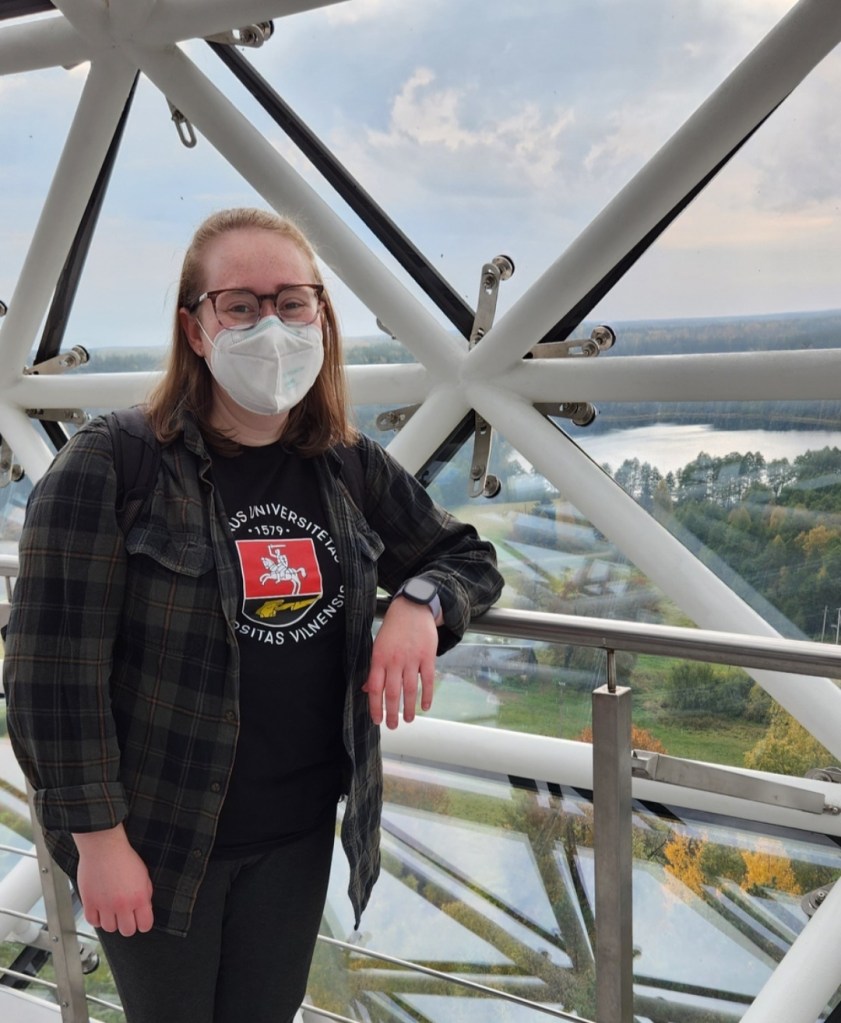
Birštonis – a neighbor to Prienai with an unbelievable view tower. The dozens of flights of stairs were worth it when we reached the top:

Molėtai – a place known for its ethnocosmology museum! As a once-aspiring astronaut, this was a must-see. The museum’s displays reminded me of Spaceship Earth at Epcot; a guide led us through the history of ethnocosmology in Lithuania, the rooms lighting up as we followed with videos and projections. There was another grueling climb up a tower, but was similarly worth the exhaustion:

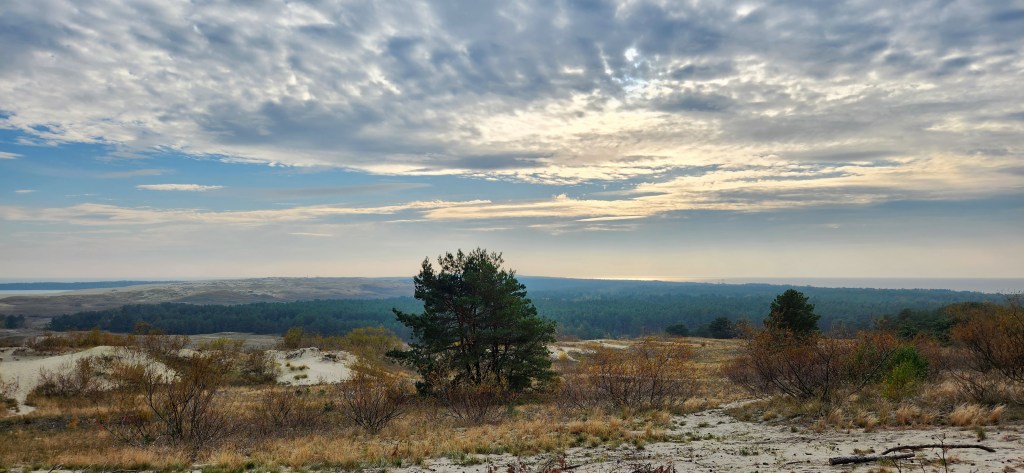
Palanga, Klaipėda, Juodkrantė, & Nida – coastal cities on the Baltic sea, leading to the Curonian Spit, a thin strip of land that juts into the water. On a long weekend trip, we: saw the Amber museum in Palanga, walked around Klaipėda, took a ferry to the Curonian Spit, walked through the woods to a beach, drove to Juodkrantė to see the Hill of Witches, and finally made it to Nida where we visited the Dunes National Park!


Research Trips
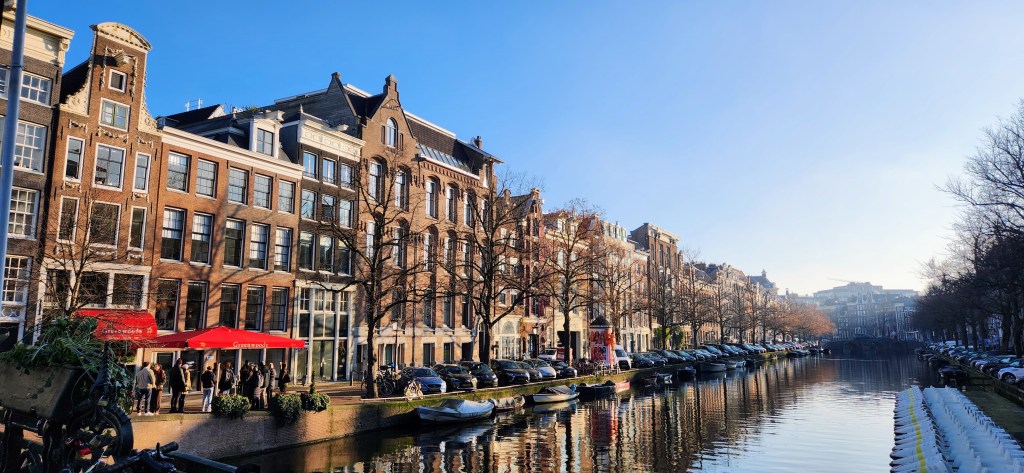
A few weeks ago, I was able to travel to Amsterdam for research. As I’m studying the diary of a Jewish young woman, it was fascinating (and moving, and tragic, and important) to visit the Anne Frank House and see how her memory is preserved. To appeal to younger generations and to keep Anne’s story alive, they’ve created a video diary series that re-imagines her writing through a modern lens.
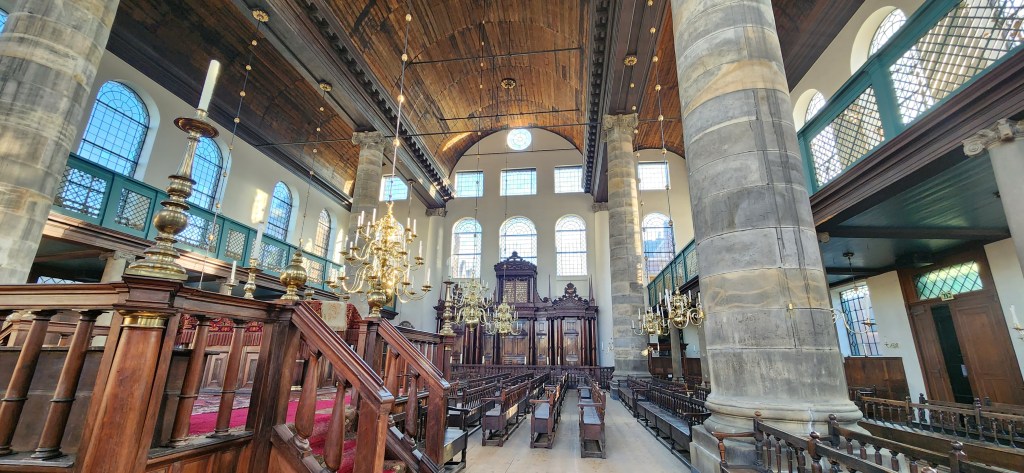
I spent hours at the Jewish Museum and Portuguese Synagogue, and heard a story that reminds me of Jewish folk heroes like Hershel (of Hershel and the Hanukkah Goblins fame): During WWII, when the Nazis had come to the Netherlands, they were planning on using the Portuguese Synagogue as a deportation center. One member of the congregation approached the regional Nazi leader and said, “Well, the windows are much too large in here. You’d want to black them out for the deportation center, and it’d be such a hassle.” Incredibly, the Nazis agreed and used a different building. While this story still has a sad ending, the bravery – and chutzpah – of this one congregant preserved their synagogue which is still in pristine condition and used to this day.
I have two more research trips planned: one to Germany to visit the Holocaust remembrance sites, and one to Poland to experience the March of the Living on Yom HaShoah.
The next four and a half months
I’ve spent most of the winter break recovering from COVID, but am ready to start the second half of my grant work.
Next semester, I’m taking the A2 Lithuanian language class, a class on communication of trauma memory, continuing with Yiddish studies, tutoring and teaching at the Ukrainian center, continuing to volunteer for the Vilnius University Museum, and starting to put together a poetry reading and exhibition for the spring.
It’s hard to believe that I’m halfway done with my grant period. It’s equally hard to put to words how impactful this time in Lithuania has been. Vilnius feels like home now, a home that I plan to return to again and again. Hopefully, I’ll be able to convince more people to visit with me––and to locate Lithuania on a map.
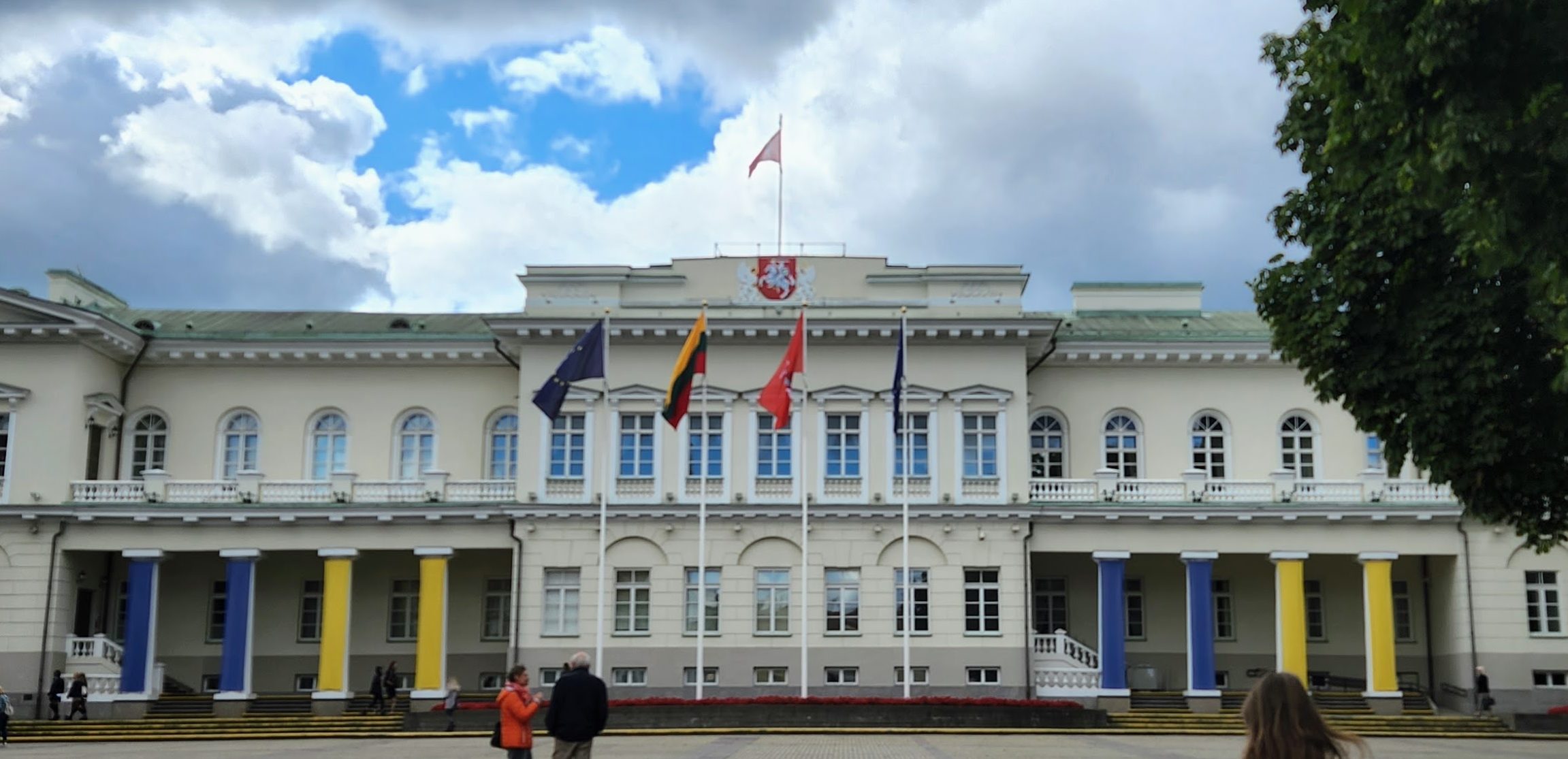
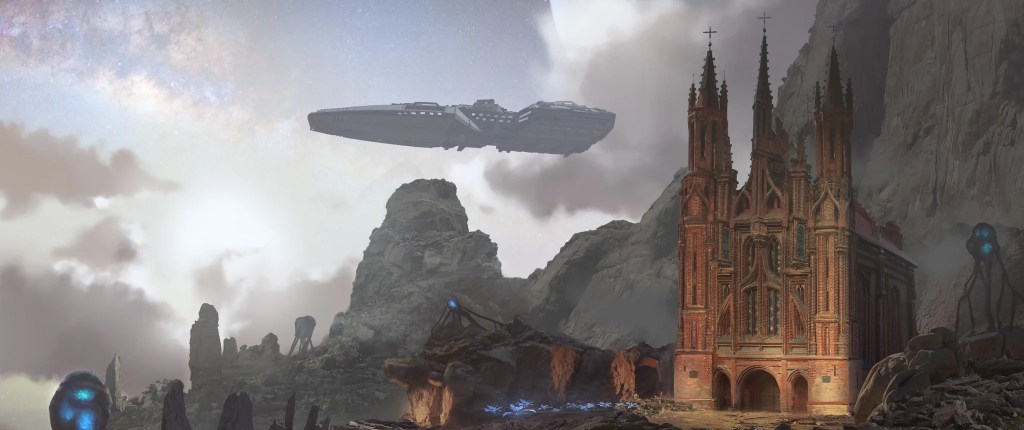
Don’t worry, this is a common struggle. The official tourism ministry’s current slogan is, “Vilnius: amazing wherever you think it is.” These are some of the photos from this campaign:


I don’t know where the second half of my grant will take me, but I know it’ll be amazing.
 The Language of Memory
Leave a comment